Nunc
Latin for now. The mark, the wordmark, the colour tokens, and the type — one reference for anyone putting Nunc on a page, a slide, or a screen.
The Phi
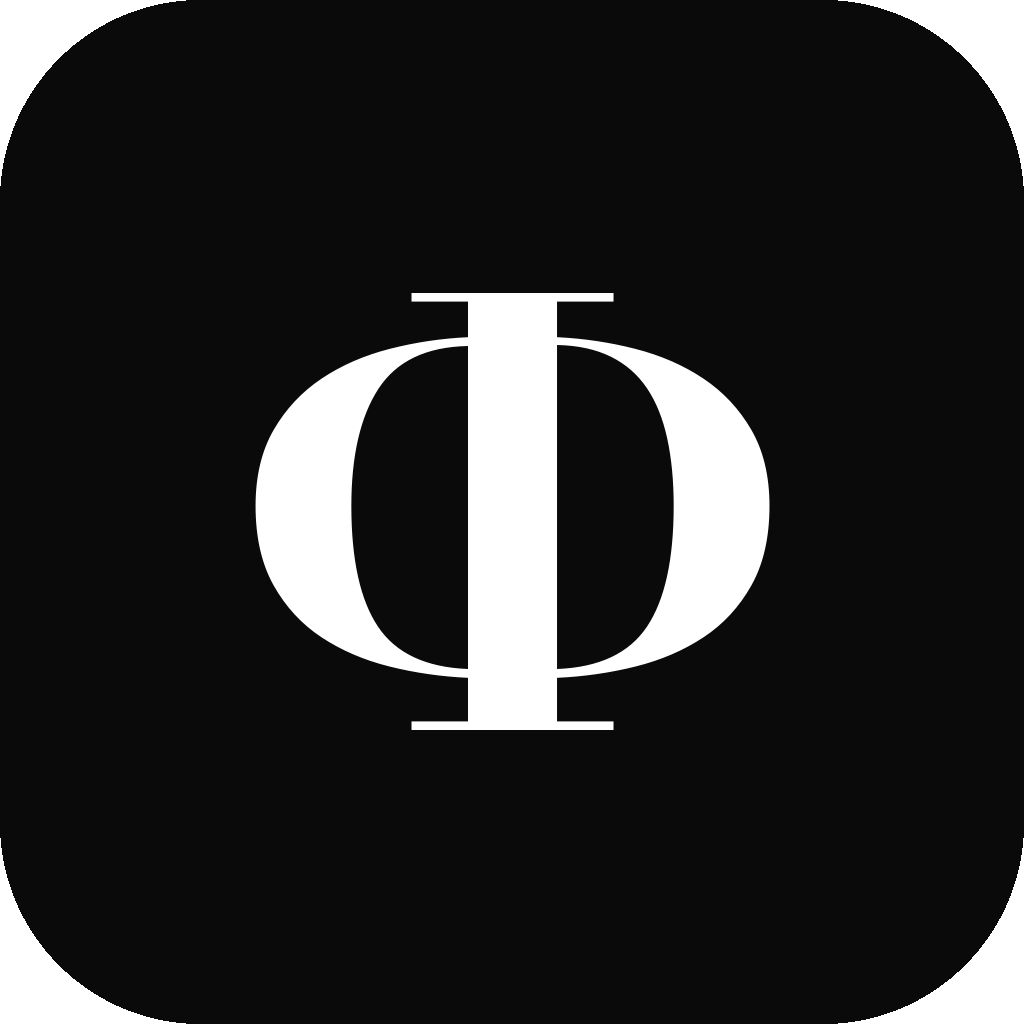
An uppercase Phi, U+03A6, the letter of the golden ratio. Set in Didot Bold, white on an ink rounded square. It is the app icon on every platform and the macOS menubar template. Balance, proportion, measured intelligence.
Sizes
Minimum 16px on screen, 6mm in print. Below that use the wordmark alone.
Clear space
Corner radius is 22% of the side. Never recolour the Phi, add effects, or place it on a photo without the square.
Menubar template

Nunc, set in Geist
Geist SemiBold, tight tracking, sentence case across both the public site and product surfaces.
The sign-off is Now. —Nunc. Use it at the end of a piece, never as a headline.
Ink, paper, four states, twenty accents
Root colours are RGB triplets in the shared tokens file. Colour and opacity always compose as rgba(var(--ink), var(--o-N)) on a five-step ramp. Dark mode swaps ink and paper — nothing else changes. Every swatch here is read from the live tokens; click one to copy.
Foundations
Semantics · the four states
- Action
- interactive: buttons, links, focus, running state
- Ok
- verified: done, approved, healthy
- Caution
- waiting on a human: approval, attention
- Danger
- blocked, failed, destructive
These are the only colours that may mean state. Action stays blue — a standing decision; interactive chrome is never orange, gold, or brand-tinted.
Accents · category, tags, avatars
For kind, never state: category markers, tags, avatars, series in a chart. Use at 60% for glyphs and hairlines, 10% for fills; full strength is reserved for the four semantics. One category system per view.
Three tiers, one scale
Didot Bold vector SVG for the seal, Geist for headings and product UI, Geist Mono for code and logs. All type sizes ride the single numeric scale, capped at 3rem (48px).
Every tool call gated, every external write approved, every action logged into evidence.
Crisp, geometric, legible at density. The body face on every surface.
workflow · prepare-990 · step 3/5
⟦PII:NAME#1⟧ approved · sha256 0e8b…2d5f
Scale · px
One scale for space, size, radius and type: caption 12, body 14, h4 16, h3 20, h2 24, h1 32, display 48. Icons are 20 or 24. Nothing off the grid.
Type ramp · live sizes
Direct, credible, calm
Nunc speaks to stewards and operators — people accountable for outcomes, not just output. Confidence comes from verifiability, never hype.
Governed by default. One policy gateway, four surfaces, six Guardian stages, durable approval gates, a content-hashed ledger.
Ownership. Workflows become private AI assets the organisation owns; a background fleet compounds what it knows.
ISO 42001-aligned, per-tenant isolation, kill switches. Claims are code-backed. Never publish a number the codebase can't substantiate.
- governed · gated · approved · logged · evidence
- your instance · your data · your audit trail
- a standing colleague that learns how you operate
- revolutionary · magic · effortless · 10×
- "AI-powered" as a feature
- fear framing — speak to responsibility, not risk
Do and don't
- Use the mark on ink or paper only; keep the square.
- Compose colour as token + opacity step. Never a raw hex.
- Let structure recede in ink; let state speak in the four semantics.
- Use accents for kind — one category system per view.
- Prefer hairlines and spacing over boxes and shadows.
- Recolour, outline, rotate, or add glow to the Phi.
- Use monochrome ink and paper; reserve blue for interactive focus and active states.
- Introduce a colour that isn't in the tokens file.
- Mix display and mono wordmarks in the same lockup.
- Publish numbers the codebase can't substantiate.
Every swatch on this page renders directly from our live shared design tokens. Questions or press requests: support@nunc.cloud