Nunc Private CloudDedicated Tenant Environment · Provisioned in Minutes

Your own private AI cloud. Zero shared tables or training logs.

Multi-tenant AI SaaS platforms pool every customer's prompts, files, and embeddings into shared tables and third-party retention logs. Nunc Private Cloud provisions a physically isolated relational store, vector index, encrypted vault, and audit ledger for your organization in minutes.

Your instance. Nothing shared.your instancededicated per-tenant boundary · nothing shared⟦PII:NAME#1⟧tokens onlycreds AES-GCM · SQL tenant-scoped · PBAC gatedData Studio WebCharts · Decks · SheetsConsolepolicies · approvalsSlack channelinbound surfaceClaude / Analytics MCP/mcp/analytics · bearerExternal agent/mcp · tools & tasksGovernance Gatewayunified policy across surfacesPBAC · budgets · Guardiangates · audit on every hopOperational storeworkflows · users · policiesdedicatedVector memoryprivate embedding indexdedicatedRealtime hublive sessions · sidecarsdedicatedObject vaultevidence · datasets · filesdedicatedAudit ledgercontent-hashed · export-readydedicatedManaged & BYOK modelsGemma 4 · Claude · GPT · DeepSeekstateless · sees tokens, never PIIallow-list validated · auditedyour databasesqueried in placePostgresSnowflakeBigQueryDuckDBClickHouseCSV · Parquetintegrationsgoverned MCPSalesforceNetSuiteSlackGitHubOneDriveBill.comJira+38 moregoverned crossing · auth, policy, Guardian, audityour data, inside your boundary
01 · Physical Data Isolation
Zero shared customer tables
Every organization receives a dedicated operational database, private 4-tier vector memory index, and envelope-encrypted object vault — never pooled behind a shared tenant_id column.
02 · Zero Training Sweep
0 bytes enter model training logs
Nunc Guardian converts sensitive fields into synthetic ⟦PII⟧ tokens prior to inference, and model calls run over stateless zero-retention routes so prompts and records never train external models.
03 · Out-of-the-Box in Minutes
Skip the 6-month DIY cloud build
Automated provisioning spins up your isolated database, vector partitions, per-seat stateful actors, and Console surface kill switches in minutes.
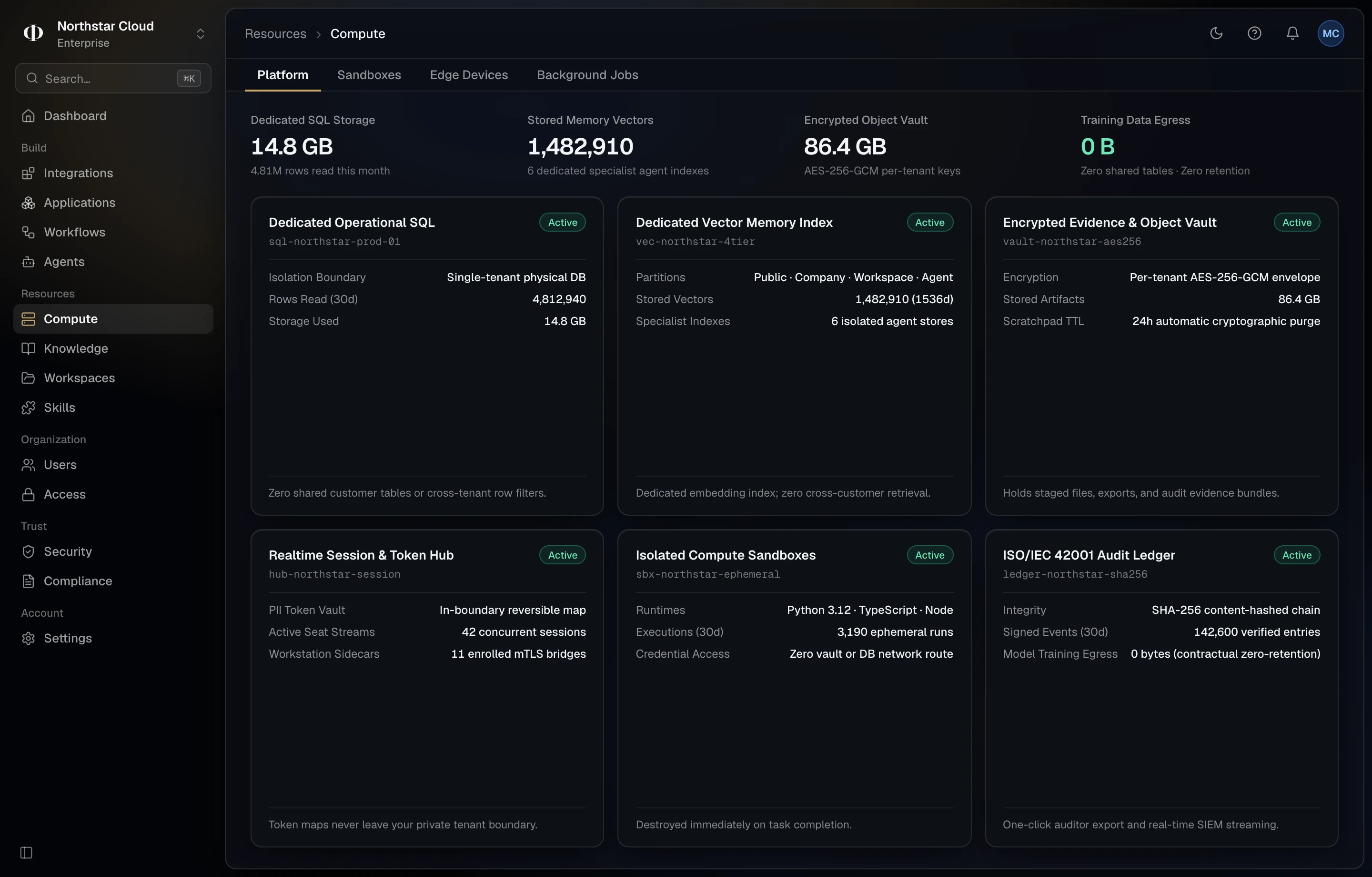
Inspect live tenant stores, per-agent memory partitions, and surface kill switches directly in Nunc Console.
Explore Nunc Console →
Managed in Nunc Console

Inspect your isolated tenant stores and runtime posture in one view.
Explore Nunc Console →
https://console.nunc.cloud/compute?tab=platform
Nunc Console Resources › Compute › Platform screen showing dedicated single-tenant relational database, 4-tier vector memory index, encrypted object vault, realtime session hub, stateful seat actor, and zero-retention inference policy
Database connections

Your data stays put. The agent comes to it.

Point Nunc at Postgres, Snowflake, BigQuery, ClickHouse, DuckDB, or a Parquet drop and agents query it where it lives — through one governed connection, with PII masked before a model is ever involved.

  • Connections are a direct query path, not a RAG copy: SQL runs in your warehouse and only the result comes back.
  • Credentials are AES-GCM encrypted inside the gateway; hosts are allow-listed; every statement passes a tenant-scope guard.
  • Result rows are tokenized before inference — names, emails, and IDs become reversible ⟦PII⟧ tokens the model never sees through.
  • The token map never leaves your instance. Answers are de-tokenized on the way back to you.
Your data stays putyour instancePostgresyour host · read-onlysql · tenant-scopedSELECT donor, amountFROM giftsWHERE fy = 2025✓ host allow-listed · scope guard3 rowsAda Byron⟦PII:NAME#1⟧$1,200Grace Hopper⟦PII:NAME#2⟧$850Alan Turing⟦PII:NAME#3⟧$2,400Guardiantokenize · reversible · the map stays insideModelstatelesssees tokensnever namesraw rows stay inside · tokens go out and come back
Between your requests

A standing colleague that learns how you operate

Background agents keep working between turns — turning operational history into rules, strategies, and cleaner knowledge inside your tenant boundary. Tenant-private, audited like everything else.

What happens between your requeststenant-private knowledgerules · strategies · entitiesnightly consolidationclusters near-dups ≥ 0.85merges duplicate insightsstrategy memorybanks strategies that workedreused on the next plan1Workflows runsteps, findings, failures recorded2Findings & failed stepse.g. Salesforce auth 401 on step 33Distills corrective rules≤5 operational rules · budget-gated4Operational rule storedconfidence 0.80 · tenant-scoped5Planner reads the rulestop-ranked operational rules6Next run avoids ittoken refreshed before the run
Operational rule distillation
finding · Salesforce auth 401 on step 3
↓
rule · refresh the SF token before any run older than 50 min · 0.80

Point-in-time findings become corrective rules the planner honours next time.

Strategy memory
strategy that worked · reconcile by GL account before by fund
↓
reused · pulled into the next 990 plan automatically

Strategies that succeeded are banked and offered back to the planner.

Nightly consolidation
3 near-duplicate entity notes · ≥ 0.85 similar
↓
1 consolidated insight · sources merged, confidence reinforced

A nightly pass sharpens the graph instead of letting it silt up.

Memory that stays honest

Because the planner acts on learned rules, a stale rule is costly. So every rule’s confidence decays on a 30-day half-life and is reinforced when it is re-learned. A rule that stops being true stops being re-learned, drops below the floor, and fades out of view — no contradiction model required. The graph gets sharper, not bigger.

background loops · scheduled runs · operational rules · anomaly monitor · background research · preference learning · action proposals · workflow promotion · strategy memory · nightly consolidation · data posture

learned operational rule · effective confidence over 90 days
Decay and reinforcement1.0.25day 090+0.15+0.15fades out of planner viewlearned · 0.80

Launch your private AI in minutes — without giving up your data.

Start a 14-day isolated Core Platform trial with $0 due today, inspect Guardian live, or speak with our team about a custom deployment.